
Introduction: Why Packaging Policy Has Become a Procurement Risk Factor
For years, food packaging decisions were driven primarily by cost, convenience, and short-term availability. In 2025, that model no longer holds. Across Europe, Asia, the Middle East, and parts of the Americas, plastic reduction laws have accelerated, transforming takeaway packaging from an operational detail into a strategic procurement issue.
What makes this shift particularly challenging is its uneven pace. While some markets have implemented comprehensive plastic bans, others operate under partial restrictions, material-specific exemptions, or delayed enforcement timelines. For buyers, importers, and food brands operating across borders, this creates uncertainty: Which materials remain compliant? Which products are export-safe? And how should procurement teams future-proof their sourcing strategies?
This article examines how global plastic bans are influencing procurement decisions in 2025. It explores the key challenges buyers face, explains how regulations classify packaging materials, reviews available data and research, and finally looks at real-world usage scenarios that illustrate how biodegradable food containers are being deployed in practice.
Industry Challenges: Why Sustainable Packaging Is Harder to Source Than It Looks
Despite the growing availability of “eco-friendly” packaging, procurement teams consistently report increased complexity rather than clarity. Several structural issues are driving this trend.
Regulatory Fragmentation
Plastic bans are not uniform. Some countries prohibit specific products such as polystyrene containers, while others target materials like oxo-degradable plastics or impose labeling requirements. Buyers sourcing for multiple markets must ensure compliance not only at the point of sale, but also during import, distribution, and waste processing.
Inconsistent Definitions
Terms like biodegradable, compostable, and plant-based are often used interchangeably in commercial materials, even though regulators treat them very differently. A product accepted in one market may be restricted in another due to differences in certification standards.
Performance Expectations Remain Unchanged
Sustainability requirements have not reduced performance expectations. Containers must still resist heat, grease, and moisture, remain stackable during transport, and maintain structural integrity throughout delivery cycles.
Procurement Risk Exposure
Non-compliant packaging can lead to rejected shipments, retailer delisting, or reputational damage. As a result, procurement teams increasingly treat packaging selection as a risk management function, not merely a purchasing task.
Materials and Standards Explained: How Regulations Actually Classify Packaging
To navigate this landscape, buyers must understand how regulators classify materials—not how suppliers market them.
A useful way to approach this is by examining how different countries group packaging materials under their plastic reduction frameworks. A high-level overview of how global regulations categorize and restrict packaging materials, including timelines and regional differences, is outlined in this global plastic ban map.
From a procurement perspective, this kind of classification-focused information is critical because it highlights what is allowed, restricted, or conditionally accepted, rather than promoting specific products.
Common Material Categories Under Regulation
1. Conventional Plastics (PP, PET, PS)
Widely restricted or taxed, particularly for single-use foodservice items.
2. Coated Paper Products
Often permitted, but increasingly scrutinized due to plastic linings that hinder recyclability or compostability.
3. Bioplastics (PLA, CPLA)
Plant-based but typically require industrial composting; acceptance depends on local waste infrastructure.
4. Natural Fiber Products (Bagasse, Molded Pulp)
Generally favored due to renewable sourcing and compatibility with composting systems.
Understanding which category a product falls into—and how it is treated in each target market—has become a foundational procurement skill.
Data, Research, and Comparative Insights: What the Evidence Shows
Beyond regulation, data-driven evaluation plays a growing role in procurement decisions.
Environmental Impact Studies
Lifecycle assessments conducted across multiple regions consistently show that fiber-based food containers offer measurable advantages:
- Lower carbon footprint compared to petroleum-based plastics
- Reduced fossil fuel dependency
- Faster degradation under industrial composting conditions
Studies indicate that agricultural-residue materials such as sugarcane fiber can reduce greenhouse gas emissions by more than 60% when compared to expanded polystyrene containers.
Market Adoption Trends
Industry surveys suggest that food brands adopting compostable packaging report:
- Improved consumer trust scores
- Higher acceptance in public procurement and institutional catering
- Lower regulatory friction during market entry
Notably, adoption rates are highest in regions with clear regulatory guidance, reinforcing the link between policy clarity and market behavior.
Cost and Supply Considerations
While unit costs for biodegradable containers can be higher, long-term analyses reveal:
- Reduced compliance-related expenses
- Lower risk of sudden material obsolescence
- Greater stability in supplier relationships
For many buyers, predictability has become more valuable than marginal cost savings.
Real-World Application Scenarios: How Biodegradable Food Containers Are Used in Practice
Understanding policy and data is only part of the equation. Procurement decisions ultimately depend on how products perform in real operating environments.
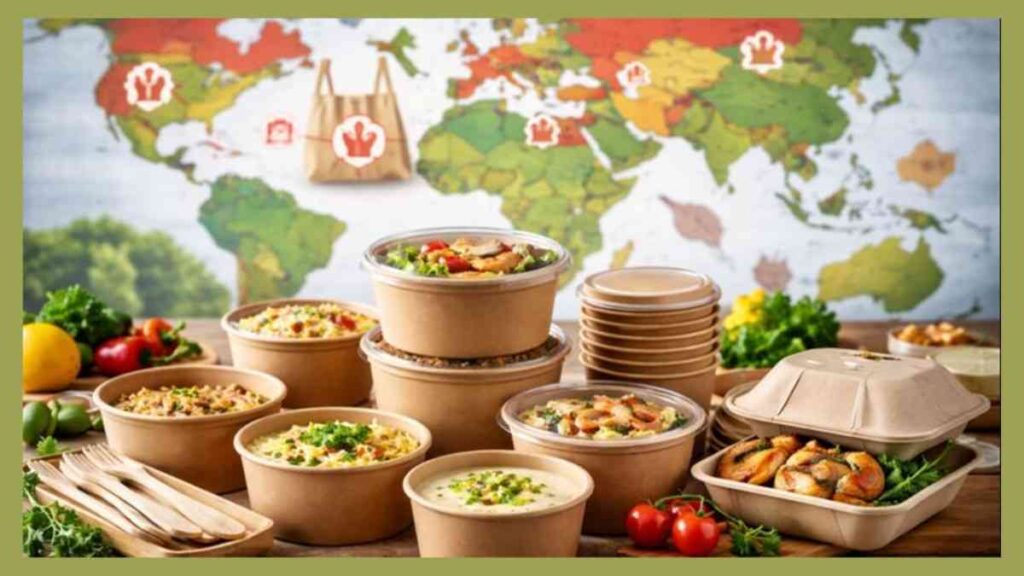
A practical reference point for how biodegradable food containers are used across different foodservice scenarios—such as hot meals, takeaway soups, and mixed-menu applications—can be seen in this biodegradable container showroom.
This type of material serves as a usage-oriented overview, illustrating how container design, material choice, and application context interact.
Scenario 1: Cross-Border Food Brands
Brands operating in multiple countries often standardize packaging to minimize complexity. Containers made from natural fibers are increasingly selected because they face fewer regulatory barriers across regions.
Scenario 2: Urban Takeaway and Delivery Platforms
Delivery-focused businesses prioritize leak resistance, heat retention, and stackability. Compostable containers that meet these criteria while remaining regulation-compliant are gaining traction.
Scenario 3: Institutional and Corporate Catering
Institutions subject to sustainability reporting requirements often require documentation of material sourcing and end-of-life options, making certified biodegradable containers the preferred choice.
Industry Signals and Supplier Developments
As regulatory pressure increases, manufacturers have begun adapting their product portfolios accordingly. Industry news has highlighted increased investment in fiber molding technology, capacity expansion, and certification alignment.
Bioleader, for example, has been referenced in trade discussions and sustainability-focused reports for scaling biodegradable container production in response to global policy shifts. Such mentions are typically framed within broader industry trends rather than direct product promotion, reflecting how supplier capabilities are becoming part of the procurement conversation.
Procurement Strategies for 2025 and Beyond
Based on buyer interviews and market analysis, several best practices are emerging:
- Prioritize regulatory compatibility over short-term pricing
- Request material and certification documentation upfront
- Conduct pilot testing in real service conditions
- Align packaging choices with future policy trajectories
These strategies help reduce exposure to sudden regulatory changes while maintaining operational efficiency.
Conclusion: Packaging Decisions in the Age of Plastic Bans
Global plastic bans are no longer abstract policy discussions—they are active market forces shaping procurement outcomes. In 2025, food packaging buyers must balance regulation, performance, sustainability, and supply stability in a way that was rarely required a decade ago.
By understanding how materials are classified, relying on data rather than labels, and learning from real-world application scenarios, businesses can navigate this transition more confidently. Packaging, once a peripheral concern, has become a strategic lever—one that can either limit or enable growth in an increasingly regulated global food economy.
